the plane
the plane on the home page is a paper dart, and it's the same one you get when you print the home page. you can also print it from here at 100%, on a4 or us letter paper.
the classic dart balances a little behind the point where its lift acts, which is why it dives or loops. so i had a computer fold a few thousand versions of it, slightly wrong each time the way real hands fold, and work out where each one balances and where its wings carry the lift. the one on the sheet is the version that still flew well after all of that. it tucks 3 cm of the nose under, has a keel that deepens to 2 cm at the tail and folds 8 mm up along the edge of each wing. it glides 1 in 4.6 where the classic dart manages 3.7, and it stays up about twice as long. i got these numbers from a computer model and haven't tested them in a wind tunnel.
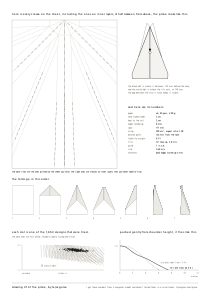
every fold on the sheet finds its own place, by lining an edge up with a line or a corner with a dot, or with a small printed ruler. the sheet only prints the lines you'll actually fold along, and only where you'll be able to see them. each instruction is printed where that part of the paper will be when you need it, so it reads the right way up, and the next fold hides it. the last few end up on the outside of the finished plane.
it flies on the equations for a glider:
dV/dt  = −g·sin γ − D/m
V·dγ/dt = L/m − g·cos γ
a glider keeps trading height for speed and speed back for height, so its path rises and falls in a long, gentle wave called the phugoid. frederick lanchester named it in 1908. he wanted the greek word for flight and picked one that really means flight as in running away.